Still Fresh… Coping with Incompetent Cervix
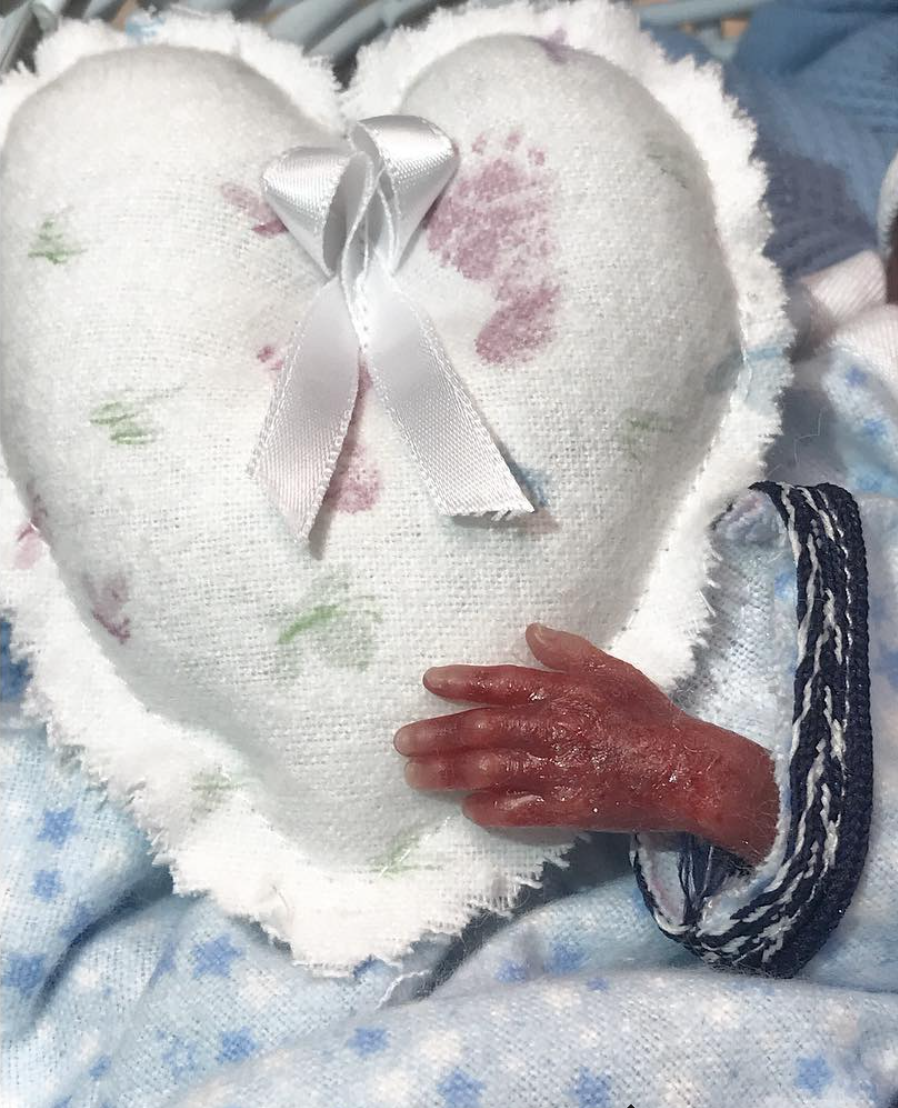
Baby Goodwin’s hand resting on a heart pillow
It feels like it was just yesterday when I lost my baby boy due to an incompetent cervix. My pregnancy was going great—as far as I knew. I had no morning sickness, no aches or pains besides my itchy, growing belly, and my baby was healthy. Everything felt normal. I felt normal. I truly believed things were going well.
I went in for my anatomy scan at 19 weeks and 0 days, and that was the moment my pregnancy went from going great to going completely wrong. During the scan, the sonographer measured my baby and checked his heart and brain development. I was nervous and scared, but she reassured me that everything looked great. However, when she checked my cervix, she became quiet. Before performing the transvaginal ultrasound of my cervix, two other women entered the room—one was a doctor, and the other was her assistant.
The doctor began asking me several questions, and that’s when I knew something wasn’t right.
“Have you had any bleeding or discharge?”
“Have you been feeling any contractions?”
“Have you had any menstrual cramps?”
The answer to all of those questions was no.
At that point, I was terrified. The doctor then explained, “The reason I’m asking these questions is because when I was measuring your cervix, I noticed that it has shortened.”I was faced with a quick and terrifying decision—one that could determine my baby’s life. I could either do nothing, or I could have a rescue cerclage placed immediately, followed by progesterone suppositories. I chose to have the rescue cerclage to try to keep my baby inside of me. I had heard about cerclages and how they had helped other women, and I clung to that hope. Before the cerclage could be placed, I had to undergo an amniocentesis—a procedure where the doctor retrieves some of the baby’s amniotic fluid using a needle—to ensure I didn’t have any infections. Thankfully, I didn’t have any infection. I checked myself into the hospital that night and had the cerclage placed the next morning.
Everything was going well after the surgery—until three days later. I woke up to a large gush of mucus, followed by leaking. I immediately panicked and told my husband to take me to the hospital. When we arrived, they tested the fluid and explained that they would need to remove the cerclage because of the increased risk of infection. Even then, I still held onto hope. After the stitch was removed, my high-risk doctor came in and explained that I had two options. I could take medication to induce labor, or I could try bed rest and hope to make it to 23 weeks. If I reached 23 weeks, I could check myself into the hospital and stay there until delivery.
I chose bed rest. I chose prayer. I chose to believe my baby would stay inside me. They monitored me, saw no contractions, and sent me home. Later that same evening, I went to the bathroom to have a bowel movement. My husband came with me because I was terrified of accidentally pushing my baby out. I didn’t push at all—I was too afraid. But after I finished, I felt something coming out of my vagina. It was my sac.
We immediately called my doctor and 911. It was around 10 p.m. Help arrived at our apartment within five minutes. I was still sitting on the toilet with my sac bulging out, surrounded by firefighters and EMTs asking me countless questions. They placed me on a stretcher and rushed me to the hospital. I was taken straight to Labor & Delivery, where I saw the same doctor who had removed my cerclage earlier. This time, however, I only had one option. I had to deliver my baby.
I was completely broken. The doctor explained that because my bag was exposed, I was at risk of developing a severe infection—one that could potentially result in my uterus being removed altogether. The only option was to deliver my baby, even though he was not viable. Let that sink in. Imagine knowing your baby is still healthy, still kicking inside of you, but will not survive once you deliver him. I was already 2 centimeters dilated, which explained why my sac had begun to slide out. They administered medication to induce labor around 11 p.m. My husband and I laid in the bed and tried to rest, as he had a game the next day.
As the contractions worsened, I asked for pain medication every hour. I received doses at 1 a.m. and 2 a.m. Around 3 a.m., I woke again and asked if I could receive an epidural—but by then, it was too late. My contractions began pushing my baby out. I wasn’t trying to push—I was terrified. I screamed to my husband and the nurse, “What’s coming out? I feel something between my legs!” Another contraction came, and my husband said, “I see our baby’s legs.”
The doctor arrived just in time before the next contraction. I was having contractions every two minutes, each lasting a full minute. The doctor said, “Just try and give me a big push.” I pushed—and felt a rush as everything fell out of me. At that moment, I knew my baby had been born… and had passed. I gave birth to our son at 3:52 a.m. on Sunday, November 12, 2017.
My husband and I watched as the doctor opened my sac and cut our son’s umbilical cord. They cleaned him and placed him back in our arms. Despite the trauma, I felt the joy of holding my baby after giving birth. I was devastated—but in that moment, joy overwhelmed the pain.
“We are hard pressed on every side, but not crushed; perplexed, but not in despair; persecuted, but not abandoned; struck down, but not destroyed.” 2 Corinthians 4:8–9 (NIV)